The Australian Standards for bollards relevant to your car park depend on your installation’s specific purpose and location. This guide explains the standards you need to consider, along with the spacing, placement, height and specifications to check before selecting and installing bollards for roads and side walks.
Understanding the importance of safety bollards in Australian car parks
Designed to enhance safety and traffic control, bollards are short and sturdy vertical posts that provide both visual guidance and asset protection.
You’ll often see safety bollards installed in shared traffic zones used by pedestrians, cyclists and vehicles, including but not limited to:
- car parks
- in front of buildings
- main roads
- footpaths
Available in a range of styles and sizes, safety bollards can act as permanent or temporary physical barricades to prevent accidental collisions and unauthorised access to restricted areas. Most importantly, bollards are used to separate pedestrian areas from motorised traffic, allowing both pedestrians and drivers to safely navigate shared spaces.
While they primarily serve as a safety and security measure, bollards can also be used to complement architectural design features.
Explore the different types of bollards
Whether you’re focusing on enhancing car park safety in your workplace or planning a new shopping centre car park, there are several types of bollards available to suit different applications.
Typically constructed from metal, concrete or plastic, the most common car park bollards can be installed as fixed, removable, collapsible, and automatic safety solutions.
Fixed Bollards
Generally made of concrete, steel or plastic, fixed bollards are permanently installed as a physical barrier in high-traffic areas like car parks, building entrances and pedestrian walkways.


Fixed bollards can also be used to prevent vehicles from accessing restricted areas that require strict security measures, such as government buildings, stadiums, and airports.
Designed to endure forceful impact from vehicles and other objects, fixed steel bollards can be galvanised or powder-coated for added protection against rust and weather elements.
Similarly, concrete and plastic fixed bollards offer enhanced durability and can be finished in a variety of colours and textures for aesthetic purposes.
Removable Bollards
As its name implies, removable bollards can be removed and replaced when required. Often used in locations where temporary access may be given, such as for maintenance crews or emergency personnel, removable bollards are popularly installed as surface-mounted, embedded, and locking varieties.


Removable surface-mounted bollards are installed on top of the ground, while embedded bollards are installed into the ground. On the other hand, locking bollards can be locked in place or removed as required.
Collapsible Bollards
Lowered into the ground when not in use, collapsible bollards are designed to be raised as a temporary barrier when needed.
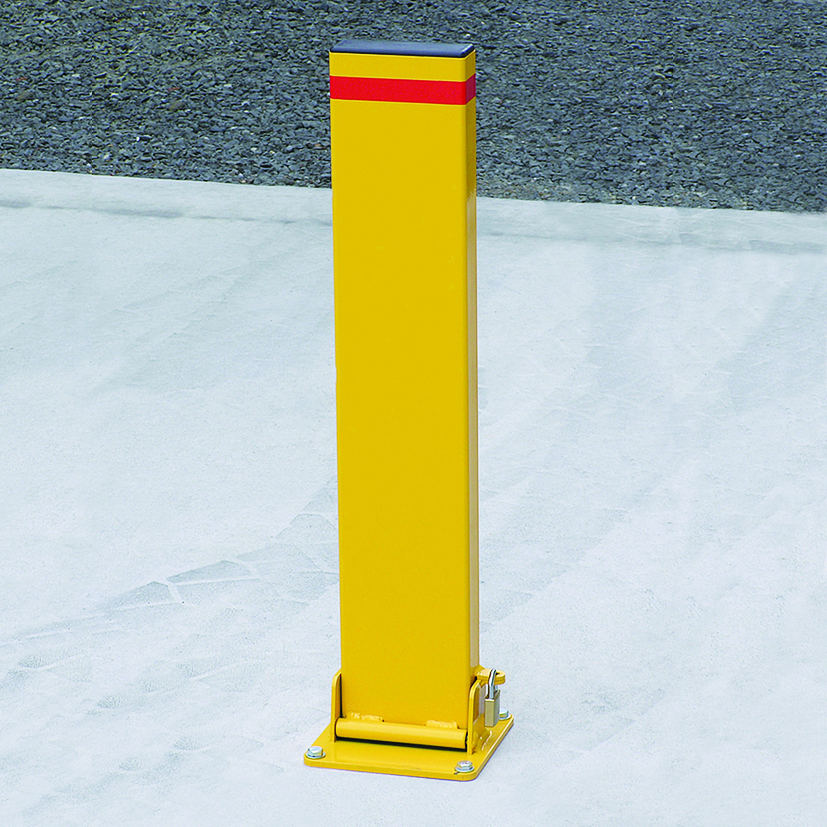
Collapsing or folding down, collapsible bollards are often used in areas with temporary access restrictions such as special events or during construction.
Automatic Bollards
Providing a secure, motorised barrier that can be controlled remotely, automatic bollards are designed to automatically rise and lower as required.
These are most commonly used to prevent unauthorised access to restricted and high-security areas, such as government buildings, embassies and military bases.
The purpose of Australian Standards for car park bollards
Australian standards for bollards help inform design and installation requirements, with different considerations for off-street car parks, on-street parking and accessible parking spaces. The applicable requirements depend on where the bollards will be installed and their intended purpose.
Components of the Australian Standards relevant to parking bollards
When the installation is being planned, review the following parking standards alongside any application-specific bollard design standards:
- AS/NZS 2890.1:2004 – Off-street car parking. Covers the design and layout of off-street parking facilities. Where the bollards are placed still needs to be considered with the wider layout, including where vehicle movement and pedestrian access must be accommodated.
- AS 2890.5:2020 – On-street parking. Covers the location, arrangement and dimensions of on-street parking facilities. Consider this standard if bollards form part of a roadside parking layout, alongside any relevant road-authority requirements.
- AS 2890.6:2022 – Off-street parking for people with disabilities. Covers accessible off-street parking facilities, including requirements relevant to bollards within shared areas.
Each applicable standard and edition should be confirmed against your project’s approval requirements, as well as drawings and specifications, before finalising the bollard dimensions and their placement.
For more information, please download our updated Car Park Safety Compliance Guide, which includes bollards.

Compliance and enforcement of bollard design according to Australian Standards
Setting out recommended rules, guidelines and specifications for design and installation in the building and construction sectors, the Australian Standards contains both mandatory and voluntary standards.
While they are not mandatory or legally enforceable unless legislated, local councils and transport authorities should actively encourage and enforce compliance with the standards.
Aside from meeting legal requirements, mitigating risk and addressing liability concerns, the standards are designed to enhance public safety and improve infrastructure as per best practices. This not only ensures the quality and consistency of products and services, but compliance with the framework also gives both businesses and consumers greater peace of mind.
Bollard spacing and placement requirements
People need to be able to move around bollards as much as the bollard spacing needs to keep vehicles out. Balancing these factors is set out under the Australian standards for bollards, which means both access and protection requirements must be specified for.
Every bollard’s diameter can also affect the required clearance. For example, Classic’s galvanised cast-in bollards come in 90, 140, 165 and 219 mm diameters, so the selected size needs to be reflected in your layout drawings.
What affects the distance between bollards?
- Pedestrian access: Bases and fixings can narrow the gap between bollards. Both should be included when checking the clear width required where AS 1428.1 applies.
- Vehicle restriction: The opening between bollards needs to restrict the intended vehicles. For impact-rated systems, follow the spacing and installation details specified for that exact system.
- Parking access: Leave room for vehicle overhang and to open doors, as well as servicing access.
Each off-street layout should be reviewed against AS/NZS 2890.1 and on-street parking against AS 2890.5, alongside applicable authority requirements. These references provide you with context for the parking design. At the same time, they should not be treated as a universal spacing rule for every bollard installation.

Bollard height and specification requirements
Even if a product suits other specifications, a supplier’s standard bollard height may still not suit every installation. Before specifying a product, check the bollard height Australian standards require for the application, as well as any other requirements that may be needed for markings and visibility.
Checking these bollard specifications can help make sure the product meets the requirements.
- Installed height: Specify the height above the finished surface. An in-ground product’s overall length also includes its embedded section.
- Accessible parking requirements: Where AS 2890.6:2022 applies, bollards require a minimum installed height of 1300 mm, together with specified retro-reflective markings and luminance contrast. Classic’s Disabled Car Park Bollard is designed for this application.
- Impact performance: Where protection against vehicle impact is specified, review the tested assembly and installation details as the height and diameter alone do not establish performance.
Once the product is specified, include the applicable standard and edition, as well as required dimensions and product documentation in the project specification so the supplier and installer know exactly what’s required. Classic can handle both processes to keep the process simple.
Classic case studies featuring bollard compliance
The Jewel Hotel – QLD

A luxurious beachfront development consisting of 512 residential apartments, 169 five-star hotel suites and retail tenancies across three majestic towers, the Jewel is the epitome of world-class living and entertainment.
Aside from supplying and installing tactiles, stair nosings and bike racks, Classic also custom-made fixed bollards to match the aesthetic in the porte cochere.
The Ambrose – QLD

With its sprawling city, river and mountain views, The Ambrose was a $150-million development located just moments from Brisbane’s best dining, retail and entertainment offerings in Milton.
A 19-storey oasis with 181 apartments in total, The Ambrose embraces its natural and urban surroundings.
Classic supplied and installed fixed bollards powder coated in yellow to separate pedestrians and traffic on the basement levels, alongside our signature stair nosings.
Melbourne Sports Centre – VIC

One of Australia’s premier sporting venues, the Melbourne Sports Centre in Parkville offers sporting facilities and programs for high-performance athletes to elite-level Olympic champions.
Engaged by Kane Constructions, Classic supplied and installed all entrance matting, tactiles, stair nosings, bollards, bike racks, speed humps and skate deterrents throughout the project.
Specifically, we worked closely with Kane Constructions to customise, supply and install a fixed bollard solution that met their application and location requirements.
Case Study: Melbourne Sports Centre
How Classic can help you supply and install bollards that are compliant with Australian Standards
Classic Fixed Bollards


Classic Removable Bollards
Classic Collapsible Bollards
Let Classic customise and fit out your car park safety solution
Dedicated to your success, Classic can supply and install your parking bollards, as well as speed humps, wheel stops, height bars, corner guards, safety mirrors and car park signage of your choice.
Architecturally designed to meet both your functional and aesthetic car park requirements, we can also customise a solution outside of our existing range and ensure your whole car park fit-out is compliant with the relevant Australian Standards.

Fulfilling your complete supply chain needs, you can rely on us to consult, design, manufacture, supply and install your proven access solutions throughout Australia.
Ensure the protection of your car parking space and its users by getting in touch with us to bring your project vision to life.