As Australian cities continue to increase in population, and urban spaces become more dense, end-of-trip facilities and bicycle parking areas are being asked to do more, with less. Whether you’re fitting out an office tower, education campus, mixed-use development or retrofitting an existing basement, the constraint is usually the same: the space for bike rack storage has limited floor area, tight access aisles, yet the number of bikes needed to be stored remains the same.
That demand isn’t going away. With the continued growth in the bike market in Australia, a market that is projected to grow at a CAGR of 4.12% between 2026 and 2035, planning for higher bicycle parking volumes is becoming a practical necessity, not a “nice to have.”
The ABS Census reporting shows 3.2% of workers used an active mode (including cycling and walking) on Census Day 2021, highlighting both current demand and the upside potential when facilities are made easier and safer to use. The pressure on planners and facilities teams is to not only meet the AS 2890.3 guidelines, which specify requirements for the construction of buildings and structures, including provisions for bike storage areas, but also to meet the demand on facilities to provide safe, convenient parking.
So how do you deliver high bay counts in a limited area? A hybrid of two high-density bike parking solutions is the perfect solution that balances density and accessibility.
What is high-density bike parking?
High-density bike storage is a space-efficient bike storage system that uses vertical and two-tier racks to increase bicycle parking capacity in limited footprint sites while maintaining safe access and AS2890.3-aligned spacing.
High-density bike parking is especially important in “limited footprint” sites like:
- Basement bike rooms with immovable columns/services
- Narrow side corridors in residential towers
- Podium levels where every square metre competes with plant or storage
- Transport-adjacent sites where demand surges at commute times
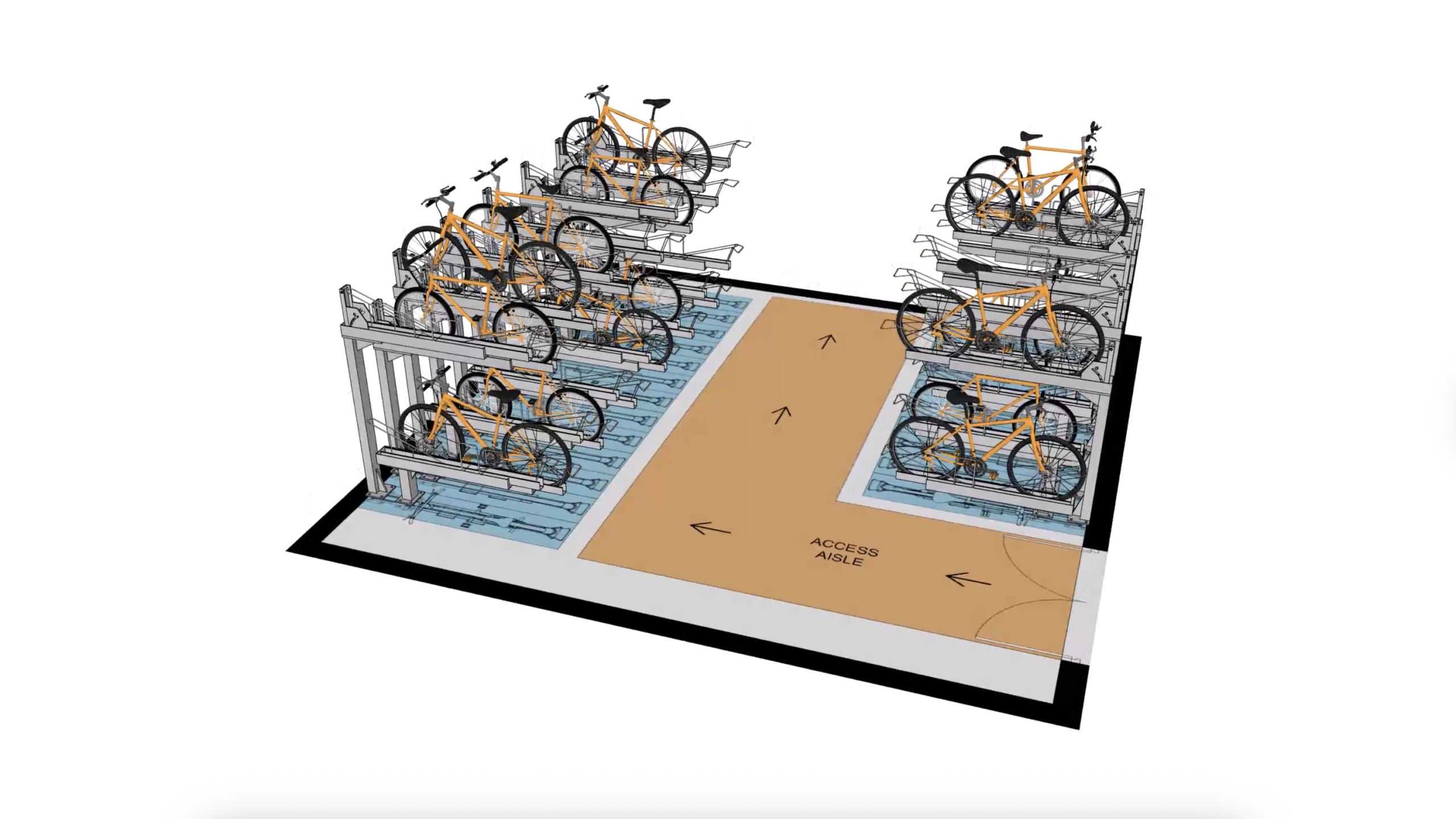
If you’re looking to increase the bike parking capacity in your facility, then you need a hybrid layout of different bike racks that optimise every inch of your bike room. A hybrid layout combines two-tier, vertical, and traditional bike racks to maximise capacity and usability, while maintaining compliance and usability.
For example, high-density zones can install double-decker racks, while vertical racks fill awkward corners and floor racks cater to e-bikes, cargo bikes, or accessibility needs. This approach tailors the space to varied users and ensures every square metre contributes to overall capacity.
Have a challenging bike rack storage requirement?
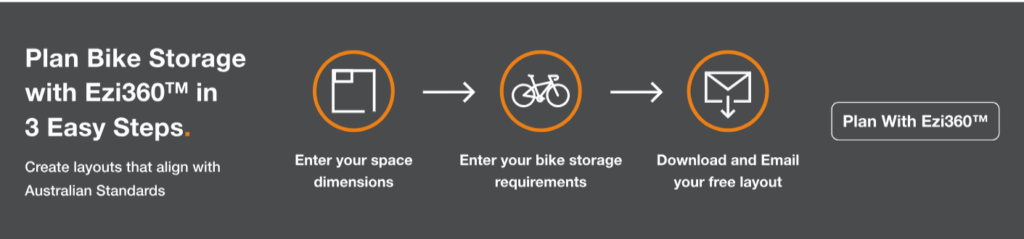
TIP: Try the Ezi360™ tool. The Ezi360™ Bike Storage Planner lets you enter your space dimensions and bike storage requirements, then automatically creates a hybrid layout tailored to your space and compliance requirements according to Australian Standards.
Vertical vs two-tier bike racks
Strategy One: Vertical Bike Racks
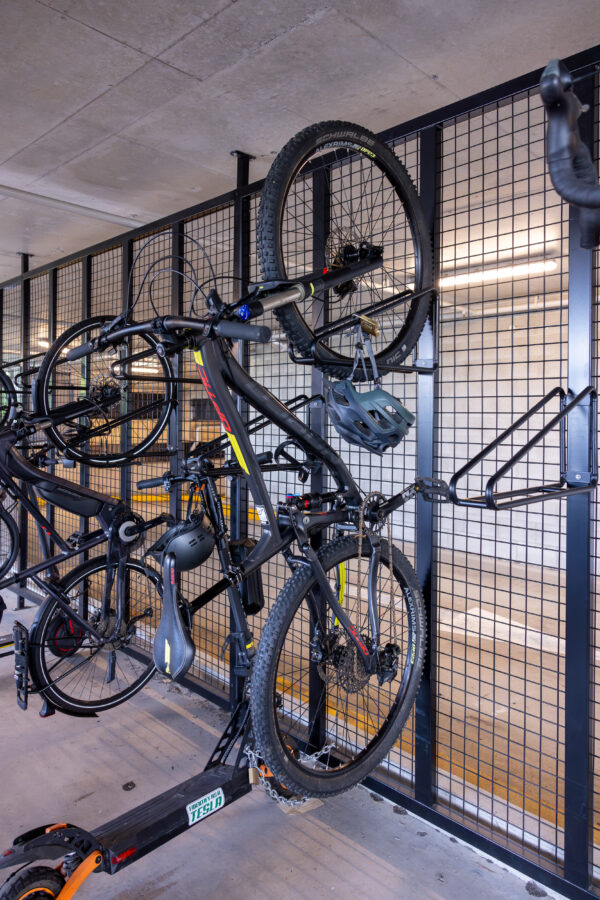
Vertical bike racks are a space-efficient option for medium-capacity rooms or irregular layouts. More accessible than some two-tier upper trays, Vertical Racks keep floors and access clear. There are options for wall-mounted and floor-mounted vertical bike racks.
When it’s best to use Vertical Racks
- long walls and tighter room depths
- smaller-to-medium bike rooms, or facilities with staggered usage
- retrofit projects where slabs/doors/turning circles can’t be changed
- Great for low-to-medium capacity rooms
Limitations of Vertical Racks
- Requires users to partially lift the bike, which may not be accessible to everyone
- Works best with standard-frame bikes and may not accommodate heavier e-bikes
Strategy Two: Two-Tier Racks (Double-Decker)
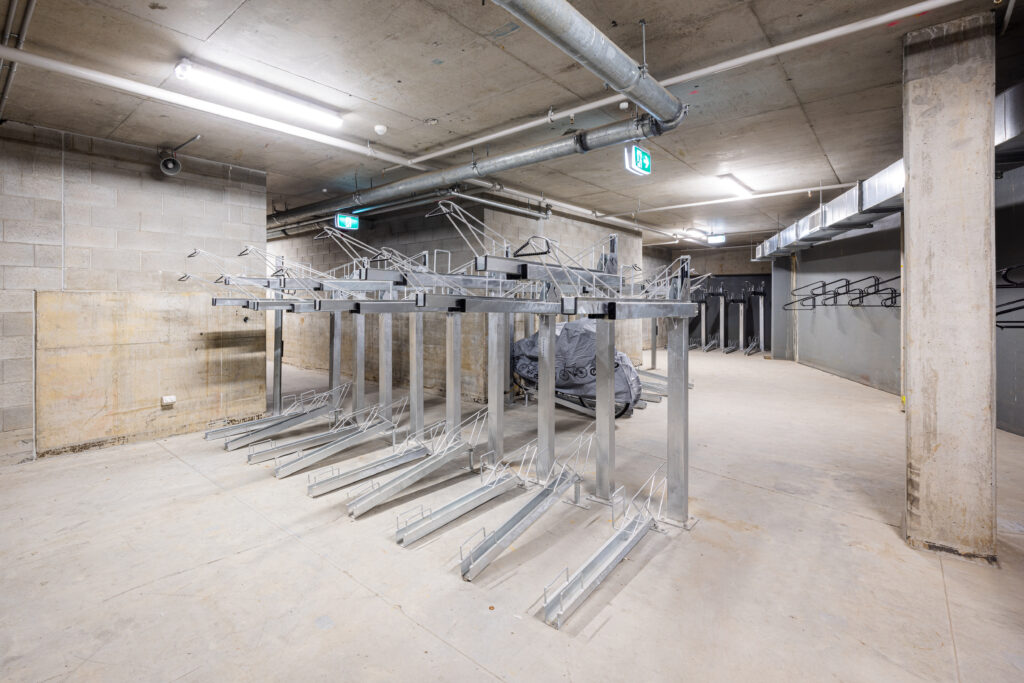
Two-tier bike racks deliver the highest density of any bike parking system. Two-tier racks are the go-to option when the brief is simple: maximising bays per square metre. They excel at exceptional capacity in floor areas with limited space, while delivering a “smart facility” look and feel.
When it’s best to use Two-Tier Bike Racks
- New developments targeting green-building ratings
- Rooms where capacity targets cannot be met due to limited space
- Offices and commercial end-of-trip facilities with peak commuter spikes
- Education, health, and civic sites with high volume and long dwell times
- Suitable for high-traffic end-of-trip rooms
Limitations of Two-Tier Racks
- Upper trays may be difficult for some users without gas-assist
- Requires higher ceilings and adequate aisle widths
- Ensure wide aisle widths to prevent bottlenecks at peak periods
High-Density Bike Storage Recommendations & Best Practices
The most successful bike rooms combine different systems and plan for real-world use.
Our best-practice recommendations for high-density bike storage include:
- Mix rack types strategically: Combine vertical, two-tier, and traditional racks for maximum flexibility.
- Plan for bike diversity: Assume 20%+ of bikes will be non-standard.
- Prioritise ergonomics: Include gas-assisted upper tiers to make it easier to lift.
- Invest in quality materials: Durable finishes and quality builds reduce long-term maintenance costs.
- Secure your space: Locking mechanisms, access control, CCTV, and good lighting improve safety and usability.
- Integrate e-bike charging: Plan charging points and fire safety from the start.
Common Mistakes & How to Avoid Them
Many issues in high-density bike parking stem from prioritising capacity over usability. Here are some common mistakes we see:
Overfocusing on capacity:
Prioritise usability over sheer numbers. Packing in as many racks as possible can backfire if users can’t easily manoeuvre their bikes.
Ignoring diverse users:
E-bikes, cargo bikes, and non-standard frames require extra space.
Poor maintenance planning:
Without regular inspections, wear and tear can build up and lead to broken racks or safety hazards. Follow a routine inspection and maintenance schedule.
Not planning for future expansion:
Demand grows. Choose systems that are scalable to avoid costly retrofits.
When NOT to Use High-Density Solutions
High-density systems are not suitable for every location. Avoid vertical or two-tier racks in:
- Locations serving elderly or less mobile users.
- Areas where heavy bicycles dominate (e-bikes, cargo bikes).
- Sites with strict accessibility requirements that make lifting difficult.
- Sites with utility pathways and circuits in the walls will not be able to accommodate vertical wall-mounted bike racks.
Recent High-Density Bike Storage Projects
LIV Albert Fields, VIC
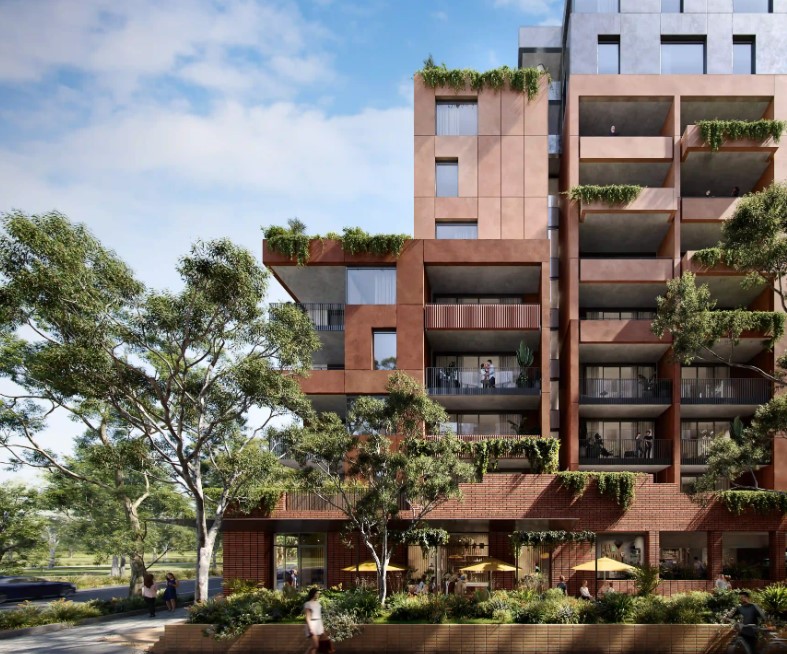
At LIV Albert in Brunswick, Classic Architectural Group installed its EziStax Max two-tier bike rack system. The space-efficient solution doubled bike parking capacity within the same footprint. This system optimises cycle-storage space and supports active-transport, meeting the building’s goal of smarter, greener living.
Final Thoughts
Vertical and two-tier bike racks are more than just space savers. They enhance the value and usability of end-of-trip facilities and make bike rooms more convenient for users. To discuss space-efficient options in your building, contact us today. Our team can provide a tailored quote for your site.